

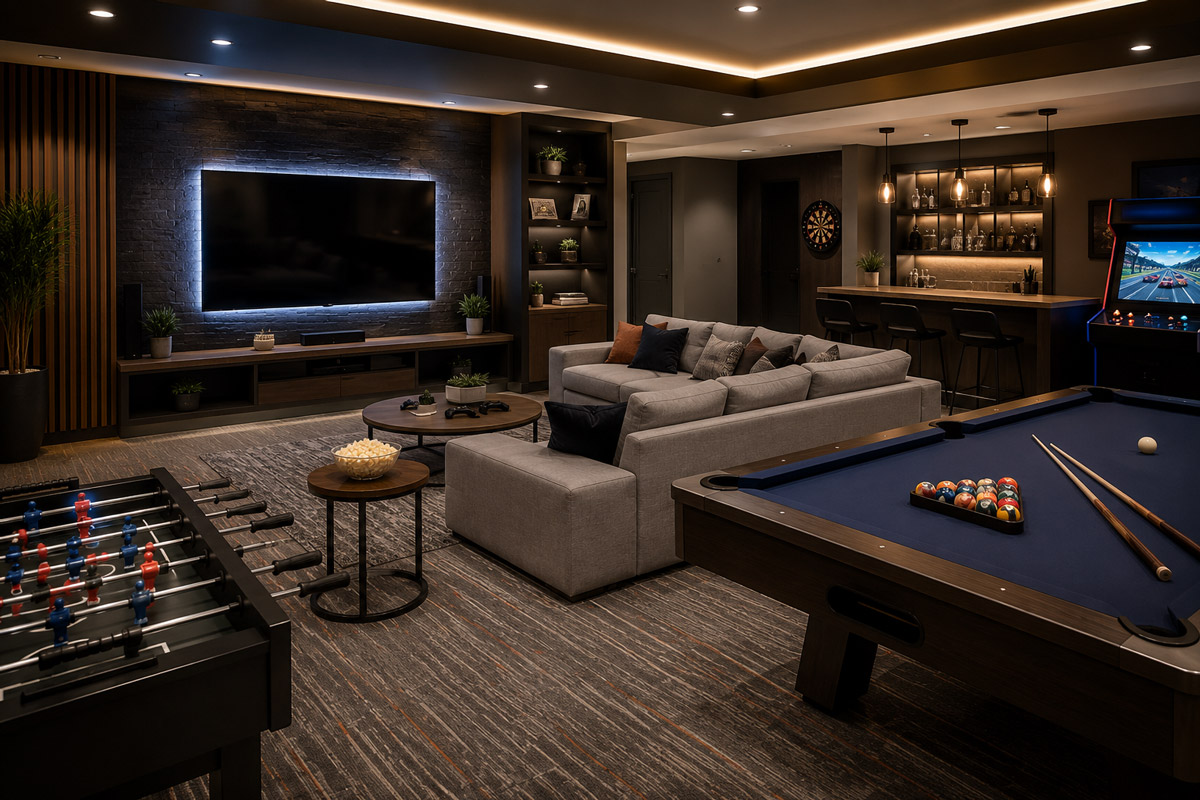
Nothing kills the excitement of a new game room faster than buying a pool table and discovering it doesn’t fit. Someone measures the room, assumes they have enough space, and then the table arrives and there’s three inches of cue clearance on one end. Every shot against that wall becomes an exercise in frustration.
Great game room ideas aren’t about picking the coolest table you can find. They’re about decisions in the right order. Space first. Anchor game second. Lighting, seating, and everything else after that. Get it right and you end up with a room people actually use. Get it wrong and you’ve got an expensive dust collector.
If you’re an Atlanta-area homeowner, you’re in good shape. Many homes in the greater Woodstock area and across Metro Atlanta have unfinished basements waiting to become the best room in the house. This guide walks you through every decision with real numbers and a clear framework so you know exactly what you need before you spend a dollar.
The Short Answer: Designing a great game room starts with your room’s dimensions, not the table you want. A standard 8-foot pool table requires a minimum room size of roughly 17 by 13.5 feet. Pick your anchor game based on available square footage first, then build your layout, lighting, and seating around it. Budget ranges run from around $2,000 for a starter setup to $15,000 or more for a full build-out.
Start With the Space: How Much Room Do You Actually Need?
Before you pick a single piece of equipment, measure your room. Not a rough estimate. Measure it. This is the most important step in any game room project, and skipping it is how people end up with a table they can’t comfortably play on.
The critical number for any cue sport is cue clearance. A standard 58-inch pool cue needs at least 5 feet of clearance on all four sides of the table. That means your room size calculation starts with the table dimensions and adds 5 feet to each side. According to Brunswick Billiards, a 7-foot table requires a minimum room of about 16 feet 2 inches by 12 feet 9 inches, an 8-foot table needs roughly 17 feet by 13 feet 4 inches, and a 9-foot table requires at least 18 feet 4 inches by 14 feet 6 inches.
What if your room is a bit tight? Shorter cues (48 or 52 inches) can reduce those clearance requirements by 6 to 12 inches per side, which sometimes makes the difference between a workable layout and one that doesn’t work at all.
Other games have their own spatial requirements:
- Shuffleboard tables range from 9 to 22 feet long and need at least 2 to 3 feet of clearance behind each end for players. A 14-foot table needs a room at least 20 feet long.
- Foosball tables are roughly 54 to 56 inches long by 29 to 30 inches wide, but the rods extend 12 to 18 inches beyond the table width when in use. Plan for a minimum room footprint of about 9 feet by 9.5 feet, according to data from Foosball Junkie.
- Ping pong tables are 9 feet by 5 feet but need serious clearance: a regulation playing area is 28 feet by 14 feet. Even casual home play calls for a room of at least 18 feet by 11 feet.
- Air hockey tables are more compact, typically 7 to 8 feet long, and can fit comfortably in a room with 10 to 12 feet of length.
Ceiling height matters too. You need at least 8 feet of clearance for comfortable cue play. If you’re working with a basement that has ductwork or beams hanging down, measure from the floor to the lowest obstruction, not the ceiling.
Choosing Your Anchor Game: Pool Table, Shuffleboard, or Multi-Game?
Every great game room has an anchor: the main attraction everything else is arranged around. It determines your budget, layout, and the vibe of the whole room.
Pool tables are the right anchor when competitive play is the goal. Shuffleboard works better for family-friendly spaces where casual fun matters more than skill. Multi-game tables (flip top combinations) are for rooms where space is limited but variety is a priority.
Think about who uses the room. Adults building a serious billiards space want a quality pool table. If you’ve got kids ranging from 5 to 15, shuffleboard is harder to tip, less likely to result in cue-related chaos, and genuinely fun for everyone. Multi-game tables make sense under 400 square feet when you can’t justify one table taking the whole footprint.
What’s the one question that cuts through the noise? “Who is this room actually for?” Answer that honestly and the choice becomes obvious.
Pool Table Setup: Size Guide and Room Clearance Requirements
A pool table is the most popular anchor game for basement game rooms in the Atlanta area, and for good reason. It plays well, holds its value, and transforms any room into a genuine entertainment destination. But sizing it wrong is a mistake you’ll feel every single time you shoot.
Here are the three standard sizes and their minimum room requirements using standard 58-inch cues (per Brunswick Billiards industry standards):
| Pool Table Size | Table Dimensions | Minimum Room Size |
|---|---|---|
| 7-foot | 3.5 ft x 7 ft | 12’9″ x 16’2″ |
| 8-foot | 4 ft x 8 ft | 13’4″ x 17’0″ |
| 9-foot | 4.5 ft x 9 ft | 14’6″ x 18’4″ |
The 8-foot table is the most popular choice for home game rooms. It plays close to regulation size (which is 9 feet in tournament play) while fitting in rooms that wouldn’t accommodate a full 9-footer.
What happens when people go too small? A 7-foot table in a cramped room feels like playing in a closet. More importantly, a table that’s too small for the player’s skill level produces awkward shots near the rail because the geometry just doesn’t work the same way. Serious players almost always prefer the 8-foot or 9-foot size.
Slate vs. non-slate: Don’t cut corners here. A one-inch or three-piece slate bed stays flat and consistent over time. Non-slate tables (slatron, honeycomb) cost less but play differently and can develop uneven spots over the years. If you’re investing in a quality game room, go slate.
At Basements and Backyards in Woodstock, we carry Imperial Billiards and Presidential Billiards tables. Both brands offer solid slate construction with real craftsmanship, and they look sharp in any game room layout.
Beyond Billiards: Foosball, Air Hockey, Ping Pong, and Shuffleboard
Pool tables get all the attention, but a well-designed game room has more than one thing to do. Layering in secondary games is what keeps the room lively for people of all ages and skill levels.
Foosball brings pure energy. It’s loud, competitive, and universally understood. A regulation table runs about 54 to 56 inches long and 29 to 30 inches wide, but factor in the rod extensions when measuring. The ITSF (International Table Soccer Federation) defines regulation dimensions, so specs are consistent across quality brands. Allow a minimum 9 by 9.5-foot footprint. It’s a great pick for kids and teens who don’t have the patience for slower games.
Air hockey is another kid favorite with a compact footprint. Most home tables are 7 to 8 feet long and fit in a space of about 10 to 12 feet without feeling cramped. The noise is real, so consider placement if the game room is near bedrooms.
Ping pong needs more room than most people expect. The table is 9 feet by 5 feet, but you need clearance to move and swing. Realistically, plan for at least 18 by 11 feet for casual play. Many game rooms use a convertible ping pong top that sits over a pool table when not in use, which is a clever space-saving option.
Shuffleboard is the adult-friendly option that deserves more attention in Georgia game rooms. It’s easy to learn, genuinely addictive, and the longer versions (14 to 16 feet) make an impressive visual statement in a basement space. According to McClure Tables, you need at least 2 feet of clearance behind each end of the table for comfortable play. A 14-foot table with proper clearance needs a room length of at least 20 feet.
Multi-game combo tables hit the sweet spot for smaller rooms. A quality combo table with flip tops for pool, air hockey, and ping pong can deliver three games in a single table footprint. They’re a genuine solution when your space doesn’t allow for dedicated tables.
Game Room Lighting: Why Your Pool Table Light Actually Matters
Lighting is the most overlooked element in game room design, and it has a bigger impact on playability than most people realize. Poor lighting over a pool table creates shadows on one side of the felt, makes it hard to judge ball position, and causes eye strain over long sessions.
The standard recommendation is to hang your pool table light 30 to 36 inches above the playing surface, according to sources including Blatt Billiards and Pool Table Portfolio. At this height, the light illuminates the felt evenly without the shade getting in the way of shots. Keep it higher than 40 inches and you start losing even coverage. Drop it much lower and it becomes an obstacle.
The World Pool-Billiard Association specifies a minimum illumination of 48 footcandles (roughly 517 lux) for competitive play. You don’t need to hit tournament specs for a home game room, but it’s a useful benchmark for understanding how bright “bright enough” actually is.
What about fixture size? Match the fixture length to the table. A 7-foot table pairs well with a light fixture around 40 to 50 inches long. A 9-foot table needs a fixture in the 60 to 70-inch range to cover the playing surface properly.
Beyond the table light, think about ambient room lighting separately. The room shouldn’t be completely dark outside the table zone. Recessed lighting on dimmers or LED strip lighting along shelving creates atmosphere without interfering with gameplay. Just don’t position ambient sources where they’ll throw glare directly onto the felt.
The Bar Setup: Pub Tables, Bar Stools, and the Social Layer
A game room without somewhere to sit and watch is just a game storage room. The social layer, the seating, the bar area, the drink station, is what transforms a space from functional to genuinely fun. It’s what makes people linger after their game instead of heading back upstairs.
The most popular configuration is a pub-height bar table (usually 42 inches tall) paired with bar stools. For watching pool, pub height seats guests high enough to see over the rail, which standard counter height (36 inches) doesn’t always accomplish.
How much seating do you need? Plan for one seat per regular player plus two spectator spots. Hosting four to six people regularly means aiming for six to eight seats total.
A dedicated drink station doesn’t have to be elaborate. A mini fridge, a small bar cabinet, and a section of counter space handles most gatherings. If you’re doing a full basement build-out in the Atlanta area, a wet bar with a sink is worth budgeting for when the basement already has plumbing roughed in. The bar cabinet also gives you natural storage for cue racks, ball sets, chalk, and accessories.
Basement Game Rooms: Turning Dead Space Into the Best Room in the House
If you have an unfinished basement, you have the raw material for the best game room in the neighborhood. Metro Atlanta homes, particularly in Woodstock, Canton, and the North Atlanta suburbs, frequently come with full unfinished basements ready for a project like this.
A few Georgia-specific things to know:
Humidity is real here. Georgia summers are hot and humid, and basements trap moisture. Before moving any wood game table in, address moisture control: check for water intrusion, run a dehumidifier during summer months, and seal concrete floors before finishing. Keep the basement between 45 and 55 percent relative humidity and your pool table frame and shuffleboard bed will stay flat for years.
Ceiling height: Most Atlanta-area basements have 8 to 9-foot ceilings, which works fine for pool. Check for ductwork, beams, or columns that reduce usable clearance. A 7-foot 6-inch clearance at the lowest point is the practical minimum.
Natural light: Basements don’t have much, which is actually fine. Controlling ambient lighting is easier without window glare, and a well-lit basement game room with the right fixtures feels intentionally designed in a way above-ground rooms rarely do.
Access and delivery: Walk the path from the driveway to the game room before finalizing a table size. Note tight turns, low clearance, and narrow doorways. Large shuffleboard tables can be a real challenge through a standard basement entrance.
Flooring Options for Game Rooms
The floor is the foundation of everything, literally. It needs to be level for pool tables to play correctly, durable enough to handle foot traffic and chair legs, and appropriate for the humidity conditions in your specific space.
Luxury Vinyl Plank (LVP) is the most popular choice for basement game rooms right now, and it earns that position. It’s fully waterproof, installs directly over concrete, comes in styles that look like real wood, and costs significantly less than hardwood. Flooring installation typically runs $3 to $15 per square foot depending on material and labor. For a Georgia basement dealing with seasonal humidity swings, LVP is extremely practical.
Hardwood looks incredible and plays well under a pool table, but it’s risky in a Georgia basement environment. Wood flooring can expand and contract with humidity changes, and in a poorly controlled basement, it can cup or buckle over time. If you want the hardwood look, LVP gives you that without the vulnerability.
Epoxy is excellent for game rooms that want an easy-clean, durable surface. It bonds directly to concrete, resists moisture and scratches, and can last up to 10 years with proper care. The industrial look works really well in basement game rooms with a modern or sports-bar aesthetic.
Rubber flooring is worth considering if the game room will see standing games like ping pong or air hockey where players are on their feet for long periods. Rubber provides natural cushioning, lasts 20 to 30 years, and is inherently moisture-resistant.
Carpet is comfortable underfoot but genuinely problematic in basements unless you use waterproof carpet tiles specifically designed for below-grade spaces. Standard carpet traps moisture and can develop mold. If you want the warmth of carpet in part of the room, carpet tiles give you the flexibility to replace affected squares if something goes wrong.
Whatever floor you choose, verify it’s level before setting up any game table. Pool table legs require a flat, stable surface, and even a slight grade affects play. A quality installer levels the table itself, but starting with a flat floor makes the whole process easier.
Budgeting Your Game Room: Entry Level to Full Build-Out
Game room costs range widely. According to HomeAdvisor, a home game room project averages $20,000, with the range running from $3,000 to $50,000. That spread reflects the difference between dropping a single table into an existing finished space versus a full basement conversion with flooring, lighting, wet bar, and multiple games.
Here’s how to think about it in three realistic tiers:
Tier 1: Starter Setup ($2,000 to $5,000)
One quality anchor game, basic overhead lighting, and minimal seating. Most of the budget goes to the table itself. You’re not finishing walls or adding a bar, just getting a playable game in the room.
Tier 2: Mid-Range Build ($5,000 to $15,000)
At this tier you can afford a quality slate pool table ($2,500 to $5,000), a secondary game like foosball or air hockey ($500 to $1,500), proper billiard lighting ($300 to $1,000), and a pub table seating setup ($500 to $1,500). This is the sweet spot for most families.
Tier 3: Full Build-Out ($15,000 and up)
Full flooring installation, a wet bar, quality sound system, multiple games, recessed and accent lighting, custom cue racks, and top-tier tables from brands like Imperial and Presidential Billiards. Finishing a basement at the same time pushes costs higher, but adds real square footage value to the home.
Splurge on the pool table. It’s the centerpiece and you’ll feel the quality difference every time you play. Save on secondary games and initial seating, and add those as budget allows.
Visit Our Game Room Showroom in Woodstock
Designing a game room is a lot easier when you can see the tables in person before you buy. Dimensions on a spec sheet don’t tell the full story. The depth of a shuffleboard table’s playing surface, the feel of a slate pool table, the size of a light fixture relative to the table it’s hanging over: these things make much more sense when you’re standing next to them.
We carry Imperial Billiards, Presidential Billiards, and a solid range of game room furniture and accessories at our showroom. Our team has helped hundreds of Atlanta-area families figure out exactly what fits their space and their budget, and we’re happy to do the same for you.
Swing by and bring your room dimensions. We’ll help you figure out the right size table, the right lighting, and the right layout before you commit to anything.
Basements and Backyards
9040 Highway 92
Woodstock, GA 30189
(678) 726-8777
We’re located in Woodstock and serve families throughout Metro Atlanta, including Canton, Kennesaw, Marietta, and the North Atlanta suburbs.
Frequently Asked Questions
What size room do I need for a pool table?
It depends on the table size. A 7-foot pool table requires a minimum room of about 12 feet 9 inches by 16 feet 2 inches using standard 58-inch cues. An 8-foot table needs roughly 13 feet 4 inches by 17 feet. A 9-foot table requires at least 14 feet 6 inches by 18 feet 4 inches. These numbers account for 5 feet of cue clearance on all sides, which is the industry standard per Brunswick Billiards.
Can I put a pool table in my basement?
Yes, and a basement is often the ideal location. Verify ceiling height (8 feet minimum), room dimensions for the table size, and moisture control. Georgia basements get humid in summer, so run a dehumidifier before your table arrives to protect the wood frame from warping.
What’s the best game room game for families with kids?
Foosball and air hockey are the best picks for households with younger kids because they’re fast, intuitive, and don’t require much instruction. Shuffleboard is excellent for mixed-age family play since it’s accessible for all ages. Pool tables work well with older kids (10 and up) who can handle the cues responsibly. Many families start with a foosball or multi-game table and add a pool table as the kids get older.
How much does a good pool table cost?
Entry-level slate pool tables start around $1,500 to $2,500. Mid-range tables with quality slate construction run $2,500 to $5,000. Premium brands like Imperial and Presidential Billiards go higher based on finish and features. Non-slate tables can be under $1,000, but the playing experience is noticeably different. For a room you’ll actually enjoy, budget at least $2,000 for proper slate.
Do I need a professional to install a pool table?
For any slate table, yes. Installation involves assembling the slate bed, leveling it precisely, and stretching the felt correctly. A poorly installed table plays inconsistently and the felt wears unevenly. Most reputable retailers, including Basements and Backyards, offer professional installation. It’s worth the cost to protect your investment from day one.