

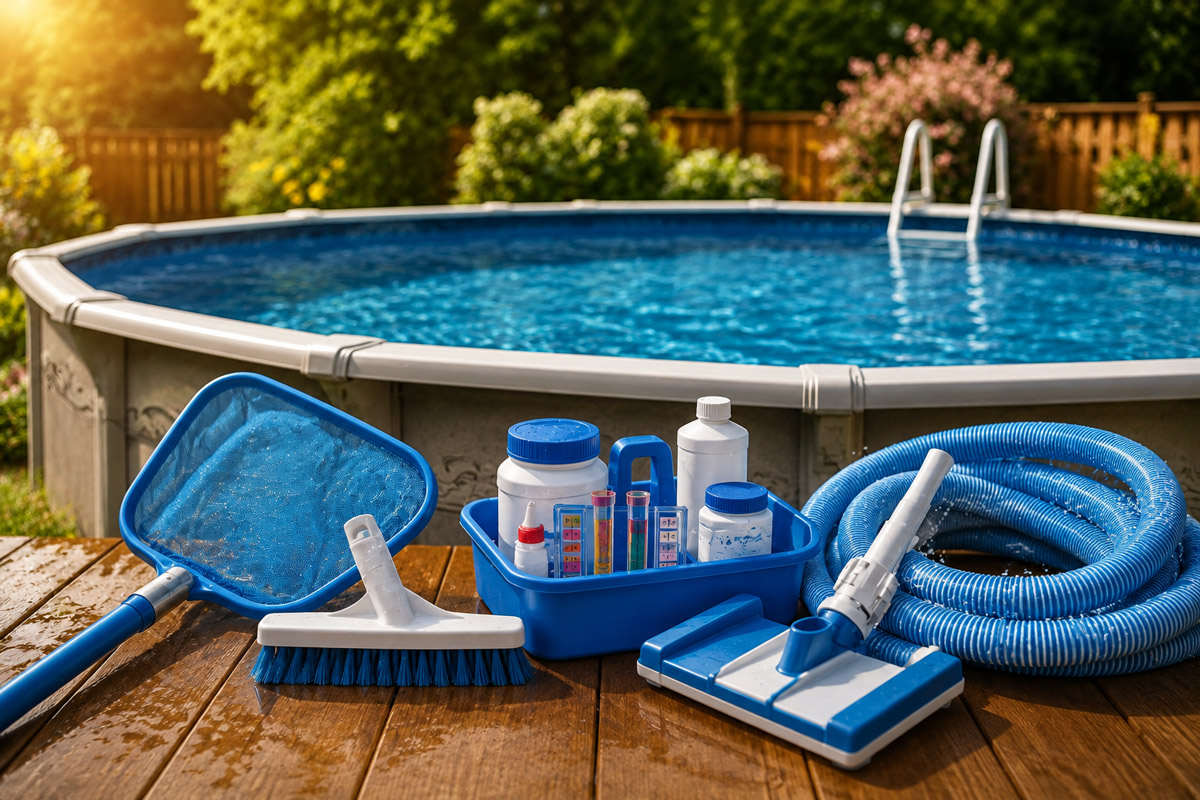
Most pool maintenance guides are written for a generic American backyard. They’ll tell you to open “in spring” and close “before winter” without specifying what that means in Cherokee County, Georgia. The above ground pool maintenance calendar that works for Minnesota will leave your Atlanta-area pool green by July.
Georgia pool owners have a real advantage: a season that stretches from late March through October or even November. That’s seven to eight months of usable water, compared to three or four months in northern states. More UV exposure burns off chlorine faster, and more humidity fuels algae. I’ve helped hundreds of Georgia families keep their pools running clean through our long, hot summers. This calendar covers every task, when to do it, and why our climate changes the equation.
The Short Answer: Above ground pool maintenance in Georgia means testing water at least twice a week from June through September (free chlorine 1-3 ppm, pH 7.2-7.6), running your pump 8-10 hours daily in summer, and timing your opening for late March and closing for October-November when temps consistently drop below 60 degrees F.
The Georgia Pool Season: What Makes It Different
Wherever you live in the Metro Atlanta area, your pool season follows a different rhythm than the national guidelines assume. The rule of thumb most pool companies use is to open when overnight temperatures are consistently above 50 degrees F and close when they consistently drop below 60 degrees F. In Cherokee County and the surrounding communities, that typically means:
- Opening window: Late March to early April
- Peak season: June through September (with 90-plus-degree days most of July and August)
- Shoulder season: May and October
- Closing window: Late October to mid-November
That’s a seven-to-eight-month season. Worth protecting.
The specific challenge Georgia’s climate creates is chlorine burn-off. Ultraviolet light breaks down free chlorine rapidly, and according to pool chemistry research compiled by Leslie’s Pool, unprotected chlorine can lose up to 90% of its effectiveness within two hours of direct summer sun. At 95 degrees F in August, your pool chemistry shifts faster than it would on a 75-degree day in the Midwest. Every recommendation in this calendar accounts for that.
The humidity matters too. Warm, humid air sitting over a pool surface is exactly what algae needs. You’ll want to stay ahead of that from the moment you open in March.
Weekly Pool Maintenance Routine: The Non-Negotiables
Consistency is what separates a pool that stays clear all summer from one that turns green mid-July. The Pool Factory recommends testing water 2-3 times per week and balancing chemicals as needed, and that’s the right baseline for Georgia’s peak season. Here’s the full weekly routine:
Water testing and chemical adjustment (2-3 times per week in summer, once per week in shoulder season)
Test for free chlorine and pH at minimum. Target ranges:
- Free chlorine: 1.0 to 3.0 ppm (Association of Pool and Spa Professionals standard; the CDC recommends a minimum of 1 ppm)
- pH: 7.2 to 7.6 (at pH 8.0, chlorine efficiency drops to only 20% according to pool chemistry studies)
- Shock weekly, even if the water looks clear
Skimming, brushing, and vacuuming
Skim the surface daily if trees are nearby. Brush the walls and floor at least once per week. Algae grows in a thin biofilm stage before you can see it. A three-minute brushing session beats a three-hour algae treatment later.
Pump run time
Run your pump a minimum of 8 hours per day during Georgia summer. Leslie’s Pool recommends one hour of run time per 10 degrees F of air temperature, so a 90-degree Atlanta day means 9 hours. Running less than 8 hours is the single most common cause of cloudy water and algae outbreaks.
Filter pressure check
Note your pressure gauge when the filter is clean. When it climbs 8-10 psi above that baseline, clean the filter. Don’t wait for cloudy water as your signal.
Is this more work than you expected? For most homeowners the full weekly routine takes 15-20 minutes. That’s a reasonable trade for months of crystal-clear water.
Monthly Maintenance Tasks
Weekly tasks keep the pool running. Monthly tasks keep the equipment alive and catch problems before they become expensive.
Deep filter cleaning
Cartridge filters need a thorough rinse every 2-6 weeks and a deep cleaning every one to three months (Leslie’s Pool). Sand filters should be backwashed every one to two months or when pressure reads 8-10 psi above normal. Sand media needs replacement every five to seven years.
Full water chemistry panel
Once a month, test beyond just chlorine and pH:
- Total alkalinity: target 80-120 ppm
- Calcium hardness: target 200-400 ppm
- Cyanuric acid (stabilizer): target 30-50 ppm
Cyanuric acid is worth a specific mention for Georgia pool owners. It protects chlorine from UV degradation. Without stabilizer, you’re fighting the Georgia sun directly. Keep it in the 30-50 ppm range. Above 100 ppm, chlorine becomes ineffective even when levels appear correct.
Liner inspection
Walk the perimeter and look for any changes: fading, soft spots, wrinkles, or small holes. A typical above-ground pool liner lasts 7-10 years, but with consistent care 15 years is achievable. Catching a small tear early means a patch kit, not a full liner replacement. Never drain your pool completely, as this can cause the vinyl liner to shrink and create permanent wrinkles.
Pump and equipment check
Clean the pump basket. Check all hose connections. Look for water stains on equipment that might indicate a slow leak. Equipment that runs all Georgia summer takes wear, and a monthly check catches problems early.
Shock treatment
Even if the water looks perfect, shock your pool once a month. Chloramines (combined chlorine) accumulate from sunscreen, sweat, and organic debris. They create that familiar chlorine smell and irritate eyes. A monthly shock burns them off.
Opening Your Pool for Spring (Late March to Early April in Georgia)
Late March is typically the right opening window for Cherokee County and the Metro Atlanta area. You’re aiming for overnight temperatures that stay consistently above 50 degrees F. Open too early and you’re running the pump in near-freezing nights without real benefit. Wait much past mid-April and you risk the water warming enough for algae to establish before your chemicals are balanced.
Spring opening checklist:
- Remove the winter cover. Pump off standing water before pulling it back so debris doesn’t dump into the pool. Clean the cover and let it dry completely before folding and storing.
- Inspect the liner. This is your first real look at the pool since fall. Check for any tears, shifts, or damage from winter. Small issues are much cheaper to fix before a full season of pressure.
- Reconnect all equipment. Reattach the pump, filter, hoses, and any return fittings. Check all connections before starting the pump.
- Fill to proper water level. The waterline should sit roughly two-thirds up the skimmer opening. Adjust with fresh water if needed.
- Run the pump for 24 hours. Let everything circulate before testing chemistry. This moves any settled material and distributes the fresh water evenly.
- Test and balance chemistry. Check pH, total alkalinity, calcium hardness, cyanuric acid, and free chlorine. Bring everything into range before adding startup shock.
- Shock the pool. Use a full startup dose of calcium hypochlorite or your preferred shock product. This kills any bacteria and algae spores that survived the winter.
- Reinstall accessories. Ladder, handrails, and any deck equipment go back in last, after the chemistry is balanced.
After a Georgia winter, even a mild one, most pools will need a dose of algaecide added to the startup treatment. The shoulder-season humidity we get in March creates favorable conditions for algae growth, especially if the closing wasn’t perfectly done.
Summer Peak Season: What Changes When It’s 90 Degrees Outside
June through September in the Atlanta area is when above ground pool maintenance gets serious. The combination of intense UV, heat, and heavy pool use creates conditions that will overwhelm a pool that was fine in May.
Increase testing frequency. During peak summer, testing every 2-3 days is not excessive. Swimuniversity and Leslie’s Pool both recommend daily testing during heat waves or after heavy swimmer loads. A pool used by a family on a Saturday afternoon can have its chlorine depleted by Sunday morning.
Keep free chlorine above 1 ppm at all times. Below that threshold, bacteria and algae can establish quickly in 90-degree water. The sweet spot is 1-3 ppm. You’ll likely need to add chlorine more frequently than the tablet dispenser alone can handle during peak season.
Plan for extra shock after heavy use. A pool party or a heavy rain event demands an extra shock treatment. Don’t wait for the water to look off.
Watch the water level and run the pump during peak hours. Georgia summer evaporation can pull an inch or more per week from your pool. A skimmer running above the waterline burns out the pump quickly. Top off weekly. Running your pump between 10am and 3pm, when UV is strongest, gives your chlorine its best chance.
Does this sound like a lot of work? The Pool Factory’s 10/60 rule applies: 10 minutes a day or 60 minutes a week is enough to maintain most residential above-ground pools when you stay on schedule. Consistency is everything.
Closing Your Pool for Winter (October-November in Georgia)
Georgia pool owners have a choice that northern states don’t get: you can close in mid-October or push all the way to mid-November depending on your schedule and the weather that year. The guidance from Leslie’s Pool and Swimuniversity is to close when water temperatures are consistently below 65 degrees F. In Cherokee County, that typically arrives in late October.
One common mistake is closing too early in our climate. If you pull the cover in September, you may be trapping warm water that’s still friendly to algae growth under a dark cover all winter. Wait for genuine cool temperatures before closing.
Fall closing checklist:
- Final balance and shock. Bring pH to 7.2-7.6, total alkalinity to 80-120 ppm, and shock the pool to superchlorinate the water before it sits. Allow 24 hours of circulation.
- Add winterizing algaecide. A quality winterizing algaecide gives you a chemical buffer against any algae that might try to establish during Georgia’s mild winters.
- Deep clean the pool. Vacuum, brush, and skim thoroughly. You’re sealing in whatever condition the pool is in, so start clean.
- Lower the water level. For most above-ground pools in Georgia, lower the water level just below the skimmer inlet. Unlike northern climates where extreme freeze depth is a concern, Georgia’s mild winters mean you’re primarily protecting the skimmer and return fittings.
- Remove, drain, and store the pump and filter. Drain all water from the pump housing, filter tank, and hoses. Store everything indoors out of freezing temperatures. Georgia pool owners don’t need antifreeze in the lines when equipment is fully drained and stored.
- Install the winter cover. Run the cable through the cover grommets and tighten evenly. An air pillow in the center of the pool before covering handles any water expansion during a hard freeze.
- Check the cover after the first heavy rain. Standing water on a winter cover adds weight that can damage both cover and pool structure. Pump it off when it collects.
Common Maintenance Mistakes (and How to Fix Them)
These are the problems I see most often with Georgia above-ground pools, discovered when the homeowner opens the pool in spring to find a green mess.
Running the pump less than 8 hours per day. It saves a little electricity and causes algae. In Georgia’s summer heat, undercirculated water goes green fast. If electricity cost is a concern, a variable-speed pump is worth the investment.
Testing only when the water looks off. By the time water looks cloudy or green, you’re already days behind the problem. Testing 2-3 times per week during peak season lets you catch pH drift or low chlorine before it becomes visible.
Ignoring pH drift. High pH is common in Georgia pools. Chlorine at pH 8.0 runs at only 20% efficiency, so you can have 3 ppm of chlorine and barely any sanitizing action. Use muriatic acid or dry acid to bring pH back to the 7.2-7.6 range.
Not cleaning up before closing. What goes under the cover in October stays until April. Organic debris left in the pool over winter feeds algae and makes spring opening much harder than it needs to be.
Pool Maintenance Supplies at Basements & Backyards in Woodstock
Homeowners across Cherokee County, the broader Metro Atlanta area, and communities up and down Highway 92 count on us for their pool supply needs throughout the season. We carry pool chemicals (chlorine, shock, algaecide, pH adjusters, stabilizer, winterizing kits), test strips and test kits, replacement cartridge and sand filters, pump replacement parts, pool vacuums, brushes, and winter covers.
If you’re not sure what your pool needs or your water test results aren’t making sense, bring a water sample in and we’ll test it on the spot. That service is part of what we do for the Georgia families who shop with us.
Basements & Backyards
9040 Highway 92
Woodstock, GA 30189
(678) 726-8777
Come see us during pool season and we’ll help you stay ahead of whatever Georgia’s summer throws at your above-ground pool.
Frequently Asked Questions
How often should I run my above-ground pool pump?
At least 8 hours per day during Georgia’s peak season. The rule is one hour per 10 degrees F of air temperature, so a 90-degree Atlanta day calls for 9 hours. In shoulder season (May and October), 6-8 hours is fine. Under 8 hours in summer leads to algae and cloudy water.
Can I leave my above-ground pool up year-round in Georgia?
Yes. Georgia winters are mild enough that a properly covered pool structure rarely suffers freeze damage. The critical step is removing and storing the pump, filter, and hoses indoors. The pool itself, with a secure cover and correct water level, handles Cherokee County winters fine.
How often should I change the pool water?
A full drain-and-refill is rarely needed more than every three to five years with good chemistry. Instead, do partial water changes of 10-20% when cyanuric acid builds above 80-100 ppm. That handles the most common reason for a water change without the hassle of a full drain.
What’s the most common above-ground pool maintenance mistake in Georgia?
Not adjusting for the heat. Georgia summers accelerate every chemical process in your pool water. Chlorine breaks down faster and pH drifts more quickly than in cooler climates. The fix is testing 2-3 times per week from June through September rather than once a week.
Do I need to winterize my pool in Georgia?
Yes, though it’s simpler than northern winterization. You don’t need antifreeze if you drain and store the pump, filter, and hoses indoors. Balance the water, add winterizing algaecide, lower the water level to below the skimmer, and cover securely. One hard freeze can crack an undrained pump housing.