

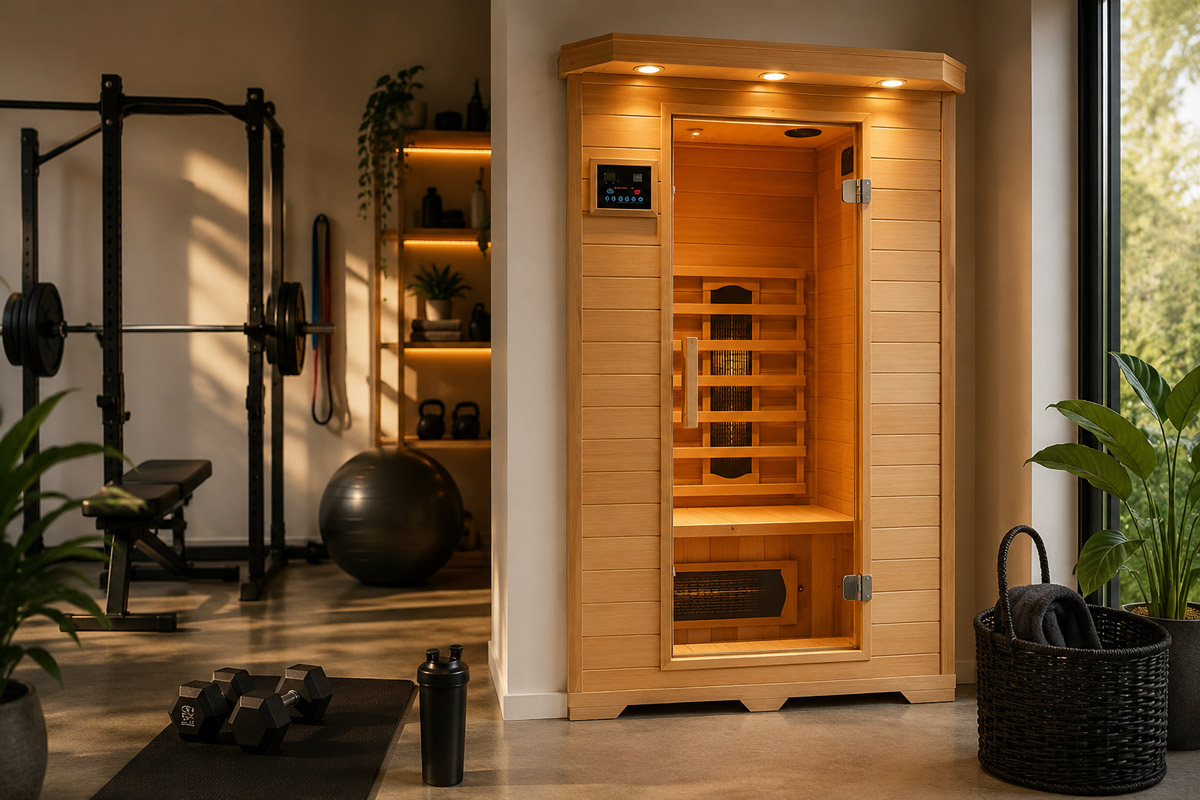
Here’s the thing about the sauna timing question: most articles about it end with “it depends on your goals,” and then walk away without actually telling you what to do. That’s not useful. Sports science has looked at this closely enough to give a real answer, and I’m going to give it to you.
The question of whether to use a sauna before or after a workout comes up constantly at our showroom in Woodstock, especially as more Georgia homeowners are building out home gym and sauna setups together. So I’ve spent time in the research, and I have an opinion. The answer is not a coin flip.
The Short Answer: Use the sauna after your workout, not before. Post-exercise sauna use amplifies recovery by increasing blood flow, triggering heat shock protein production, and producing a growth hormone response that compounds what exercise alone creates. One study found that three weeks of post-exercise sauna bathing increased endurance run time to exhaustion by 32% (Scoon et al., Journal of Science and Medicine in Sport). The exception: if you’re a competitive endurance athlete specifically training for a hot-weather event, pre-workout heat acclimation has real evidence behind it.
After Is Usually Better: Here’s Why
The sauna-after recommendation isn’t arbitrary. It’s grounded in what your body is already doing when you finish a workout.
When you stop exercising, your muscles are in an active repair state. You’ve created micro-tears in muscle fibers, depleted glycogen, and triggered an acute inflammatory response. That inflammation is not a problem to suppress. It’s the signal that kicks off repair and adaptation. The question is how efficiently your body can run that process.
Post-workout sauna use accelerates it. Heat causes vasodilation, meaning your blood vessels widen and blood flow to muscle tissue increases substantially. That increased circulation delivers more oxygen and nutrients directly to the tissue that needs them most, right when they’re needed. Research published in Frontiers in Sports and Active Living found that repeated post-exercise infrared sauna sessions improved neuromuscular performance recovery and reduced muscle soreness after resistance training, with the most significant gains appearing with three to four sessions per week over three weeks.
The growth hormone response is where the numbers get interesting. A Finnish study found that sauna exposure alone can produce a 16-fold increase in circulating growth hormone levels with repeated heat exposure. When you combine exercise and post-workout sauna, the hormonal response is synergistic, not additive. The growth hormone increases observed after exercise plus sauna were found to persist into the 24-hour period following treatment in all resistance training groups studied, according to research published in JAMA Internal Medicine. Growth hormone matters here because it directly drives muscle repair, protein synthesis, and tissue recovery.
What about cortisol, the stress hormone that can interfere with recovery if it stays elevated? Research has found that serum cortisol decreased in both far-infrared and traditional sauna groups after exercise, with cortisol at its lowest point at the end of the recovery period. That’s the direction you want if your goal is recovery and adaptation.
Citation capsule: A study published in Frontiers in Sports and Active Living (Ahosalo et al.) used a randomized crossover design with male basketball players who performed a resistance exercise protocol followed by either 20 minutes of passive recovery or an infrared sauna session at 43°C. The sauna group showed less severe muscle soreness and higher perceived recovery compared to passive rest.
What Happens to Your Body During a Post-Workout Sauna Session
It helps to understand the mechanics, because “it increases recovery” is vague to the point of uselessness. Here’s what’s actually happening.
Vasodilation and nutrient delivery. Heat causes your blood vessels to dilate, increasing cardiac output and sending more nutrient-rich blood to muscles that are actively repairing. Think of it as widening a highway when traffic is heaviest.
Heat shock protein production. Heat shock proteins are molecular chaperones that your body produces under thermal stress. They refold damaged proteins, clear cellular debris, and protect cells from further damage. Infrared heat stimulates heat shock protein production at lower ambient temperatures than traditional saunas because the infrared energy penetrates tissue directly rather than heating surrounding air.
Cardiovascular clearance effect. The elevated heart rate during a sauna session resembles light aerobic exercise, which helps flush metabolic byproducts like lactic acid from muscle tissue. The sauna acts like a gentle active cooldown that keeps circulation moving while heat does its work.
Cortisol clearance. In the acute phase after a hard workout, cortisol is elevated. Research consistently shows post-exercise sauna use accelerates cortisol reduction, which supports testosterone-to-cortisol ratios that favor muscle building and recovery.
When a Pre-Workout Sauna Actually Makes Sense
I said post-workout is better for most people. But “most people” isn’t everyone, and I want to be specific about the exceptions.
Heat acclimation for endurance athletes. If you’re a runner or cyclist preparing for hot, humid conditions, pre-workout sauna exposure is a legitimate strategy. Repeated heat exposure increases plasma volume, which allows your cardiovascular system to deliver more oxygen under heat stress. Research in the Journal of Science and Medicine in Sport showed three weeks of post-exercise sauna bathing produced a 7.1% increase in plasma volume and a 32% increase in run time to exhaustion. Some coaches also use pre-workout heat exposure to prime the thermoregulatory response before hot-weather races. Talk to your coach if you’re planning this approach.
Warming up for mobility work. If your session focuses on flexibility or passive stretching rather than high-intensity training, a 15-minute pre-session sauna has physiological merit. Warm tissue stretches more safely and more completely than cold tissue.
Where pre-workout sauna backfires. A study in the Journal of Science and Medicine in Sport found that 30 minutes of sauna before a cycling test reduced power production. Heat stress before high-intensity work elevates core temperature and causes dehydration before you’ve started. If you’re lifting heavy, sprinting, or doing anything demanding, skip the pre-workout sauna entirely.
For performance-focused training, sauna goes after. Pre-workout sauna only earns its place in specific heat-acclimation or mobility contexts.
How Long Should You Wait After a Workout Before Getting In?
Don’t walk out of the weight room straight into the sauna. Give your body 20 to 30 minutes first.
During intense exercise, your core temperature is elevated, your heart rate is high, and you’re already dehydrated. Stacking a 190°F sauna on top of all that immediately puts your thermoregulatory system under compounding demands. The American College of Sports Medicine warns that overlapping intense exercise with heat exposure significantly increases core temperature and dehydration risk.
The wait window lets your heart rate approach resting, your core temperature stabilize, and gives you time to get fluid in before adding more sauna-induced sweat loss. You don’t need to be fully cooled down. Starting the sauna while still slightly warm is fine and may help you acclimate faster. But the peak intensity needs to have passed.
Practical check: if your heart rate is still above 100 bpm, keep waiting.
How Long Should Your Sauna Session Be?
The research protocols that showed measurable recovery and performance benefits used sessions of 20 to 30 minutes. That’s your target range.
The Scoon et al. study used 31-minute sessions in a traditional sauna at approximately 90°C. The infrared sauna studies that showed neuromuscular recovery improvements used 20-minute sessions at 43°C. For most people, a 20-minute post-workout session three to four times per week is a reasonable and well-supported protocol.
What about longer sessions? Going 45 minutes or longer after an intense workout adds more thermal stress without proportionally increasing recovery benefit, and it significantly increases dehydration risk. More is not automatically better here.
Exit the sauna immediately if you feel dizzy, nauseous, or notice a sudden sense of cold despite the heat. That last one is counterintuitive but real. A sudden sensation of chilling inside a hot sauna can indicate your thermoregulatory system is becoming overwhelmed. Don’t push through it.
For frequency: three to four sessions per week is what the evidence supports. Daily sauna use doesn’t appear to be harmful for healthy adults, but the growth hormone response diminishes with repeated daily exposure. Alternating sauna days with rest or lighter training days may preserve more of the hormonal benefit.
Hydration: The One Thing Most People Get Wrong
You sweat heavily during a workout. You sweat heavily again in the sauna. Stack those back to back and you’re looking at serious fluid loss that can negate the recovery benefits you’re after.
Sauna sweat loss reaches approximately one liter per 20 to 30 minutes. After a moderate workout you may have already lost 500 to 1,000ml. The bigger problem most people have: replacing the water without replacing the electrolytes. You lose sodium, potassium, calcium, and magnesium in sweat. Plain water doesn’t restore them. Without sodium specifically, your body struggles to retain the fluid you’re drinking.
Practical protocol:
- Drink 16 to 20 ounces immediately after your workout, before entering the sauna
- Sip 4 to 8 ounces every 10 minutes inside
- After the session, rehydrate with an electrolyte solution containing roughly 1,000mg of sodium per liter
- On training days with sauna, target 30 to 50% more total fluid than a normal day
Avoid alcohol. It’s a diuretic, compounds dehydration, and impairs your ability to gauge how overheated you’re getting.
Setting Up a Home Sauna and Gym Combination in Your Atlanta Home
More Woodstock-area homeowners are pairing home gyms with dedicated sauna spaces, and proximity matters more than most people expect. If your gym is in the basement and your sauna is in a detached garage, the friction of that 20-minute wait becomes a barrier. Most people just skip it.
The ideal setup keeps the sauna accessible from your workout space, ideally on the same floor, with space nearby to cool down and rehydrate during the wait. For most Georgia homes, basements and finished bonus rooms work well. Good ventilation and a moisture-resistant floor are the main practical requirements.
At Basements & Backyards, we carry Sirona and Premium Hemlock infrared saunas that work well in home gym configurations. Infrared units reach operating temperature in 15 to 20 minutes, which fits naturally into the post-workout wait window. Start the sauna when you finish your last set, and it’s ready when you are.
Atlanta’s fitness culture is serious, and the home wellness space has grown throughout Woodstock, Georgia and Metro Atlanta. If you’re considering adding a sauna to your gym setup, come see us at 9040 Highway 92, Woodstock, GA 30189, or call (678) 726-8777.
Frequently Asked Questions
Can I use a sauna every day after workouts?
Safe for healthy adults, but the growth hormone benefits appear strongest at three to four sessions per week. Research suggests the hormonal response diminishes with daily repeated exposure. On heavy training days, use it. On lighter days, skip it.
What should I eat or drink before a post-workout sauna session?
Drink 16 to 20 ounces of water before entering. Avoid large meals within 60 to 90 minutes. Your digestive and thermoregulatory systems compete for blood flow, and that combination can cause nausea. A small snack is fine. Save the full meal for after.
Is it safe to use a sauna after lifting heavy?
Yes. Wait the 20 to 30 minutes, hydrate, and keep the session to 20 minutes. The wait period matters more after heavy strength work than after moderate cardio because cortisol and core temperature are both elevated. The Ahosalo et al. study specifically used a maximal strength and plyometrics protocol before the infrared sauna session, and the sauna group showed better recovery than passive rest.
Does sauna help with weight loss after workouts?
The direct effect is modest. A 30-minute session burns roughly 150 to 300 calories, and the immediate scale drop is water weight. The indirect case is stronger: better recovery lets you train harder more consistently. A Binghamton University study found infrared sauna users saw a 4% body fat reduction over several months. Treat sauna as a recovery tool. The weight management follows from better training quality, not from sitting in heat.